Posts

Stag beetles, Devils Coach horse and a couple of others.

Image
Devil's coach-horse beetles   Ocypus olens or   Staphylinus olens as they once were  classified are still out and about here but with the current cold they will need to be finding winter cover soon, one of the many species that may find a place in our house if they are lucky. They along with the Stag beetles have had an exceptional 2013 around here and I have never seen so many, at times it has been hard to avoid them and quite large numbers ended up being squashed on the roads. Although they are both common species it seemed worthy of a mention  due to their completely different biologies. In French the  Devil's coach-horse is simply call ed "le diable" , the Devil or "le Staphylin odorant"  literally  smelly staphylin due to the foul odour it emits from a pair of white glands at the end of its abdomen. They belong to the  rove beetle family ( Staphylinidae ) and are well known for raising their abdomens, and opening their...

The tragic decline of the Red Kite in France continues.

Image
I remember back in the early 1990's when we lived in mid Wales being able to regularly see a couple of the UK Red Kites that there were remaining at that time and all very secretive it was, not something to be advertised! Who would have thought then that there would be such a fantastic recovery resulting in the numbers to be seen today in the UK following some introduced reinforcements? A true success story even if there are still some "local issues". In France, just as in the UK, the Red Kite was just about everywhere in the 17th century, seen equally over "the streets of Paris as over the streets of London". Again just as in the UK the Red Kite in France and other Continental European countries had declined dramatically by the middle of the 20th century. The decline slowed down in France , with population sizes even increasing from the start of the 1970's largely due to the protective measures put in place (with legal protection for all birds of prey ...

Roe deer in the early morning mist.

Image
Finally I got round to buying a Trail Camera and this is my first capture other than a hardly visible rat scurrying around in the dark and a feral cat that roams around the immediate area. The model I’ve bought is a NatureView Cam HD Max 119439 and I’m hoping it comes somewhere near their glowing sales pitch! I like the idea of the two close focus lenses 25 and 46cm for use with a bird feeding station and the automatic switch from daylight colour to darkness IR.     Of course there is the small matter of what’s actually around, some of which I’m already aware of from either actual sightings or traces. The Roe deer I see quite often and plenty of Red squirrels when they decide to show themselves. Occasionally I have sightings of Marten and Weasel, (dawn or dusk), but I more often see their excrements although I haven’t seen any for a month or two and I suspect I may have to resort to a bit of “baiting” to try and attract some creatures to a feeding zone.   Any...

Three hairy caterpillars and an ichneumon.

Image
I've been coming across three common hairy caterpillars for the last few weeks as I do every year in autumn and although they are widespread and common I thought I'd just pop them on here. Anyway, I often find that caterpillars are prettier than the moth or butterfly they will end up as one day if they make it AND they don't fly away when I want to take a photo! These three all spend the winter as a caterpillars and pupate in the spring. The Fox Moth Macrothylacia rubi is called either  Anneau du diable  or Bombyx de la ronce in French. They belong to the f amily of Lasiocampidae and as one of the French names  Bombyx de la ronce implies one of its preferred food plants is bramble, (no shortage of that on our land), although they will happily eat a range of food plants including different species of heather. Moth here. The Ruby Tiger   Phragmatobia fuliginosa   is called  Écaille cramoisie in French and belongs to the family  Arc...

Poor year for wasps and hornets

Image
As far as I can gather this really hasn't been a good year at all for the social wasps including Hornets in much of France . It’s that bad first 6 months to the year again that caused all the problems, cold nights and too wet, especially bad for the ground nesting wasp species. Now I guess a lot of people will be happy with this as they are a group of insects that people generally love to hate, or if hate’s too strong a word, dislike intensely. Broadly I can understand why, they are known to sting in certain circumstances and very few people actually enjoy pain or the reaction that can sometimes follow, swelling, itching, soreness and so on although in reality most people are rarely stung or experience very strong reactions if they are.  Of course as usual the media plays a largely negative role with "shock stories" should someone actually die, usually as a result of disturbing a nest and receiving a large number of stings, or perhaps because they are one of the ...

Feeding my bees

Image
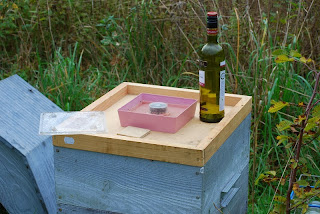
Usually I don't need to feed any of my bees before winter but due to the bad weather this year, especially the first 6 months, everything was behind with some colonies swarming as late as July with a corresponding slow build up in colony population strength. As things worked out it wasn't too bad by the end of August although the honey yield was poor, probably only about a third of what it should have been. Most hives were already well loaded and heavy with honey for the winter leaving all of September remaining to forage the ivy which was abundant this year. Ivy, a much maligned plant, is a great source of nectar and pollen for the bees at the end of the season and plays an important role for a number of species. However I had half a dozen underweight colonies from late reared Queens and I've been feeding these to boost their population size and hopefully get them up to weight with sufficient honey stores to get them through winter but I'm still left with th...

29th International Ornithological Film Festival Ménigoute

Image
This week it's  the 29th International Ornithological Film Festival at Ménigoute, Deux-Sevres, Poitou-Charentes and I'm really looking forward to spending some time there on Thursday. Festival runs from 29th October until 30th November and I s hould say right from the start it's a lot more than films and  however good the films may be  it's the other things that interest me, especially spending a bit of time looking, (drooling), at all the optical kit, cameras, field glasses and scopes I can't afford. Not that I can't get by with what I've got but it's like everything else, it would always be nice to have better things and there really are some incredible optics available these days.  Hmmm, best stop dreaming. I must mention before anything else that the first thing to grab my attention was this stunning old bee "hive" apparently about 150 years of age. I just love this type of thing however  impractical it may have been compared to...