Posts

Showing posts from 2013

Bee eaters 2013

Image
Bee eaters have been another victim of the poor weather we had for the first 6 months of this year and I’m sure there is going to be quite a list of losers as the figures come in and verify what I have already heard, seen or suspected. Only 32 couples were recorded nesting in the Vienne department this year, less than half the number we have been seeing in recent years. Only two sites maintained their normal numbers, a quarry and a riverside location.  On the 9 sites that were used there were between 1 and 14 pairs. Nesting took place extremely late with no young birds visible at the tunnel entrances as late as mid July.  This species was undoubtedly severely affected by the unusually wet and cold weather we experienced even into the month of July resulting in a substantial loss of flying insects or decent weather to hunt for them. It’s more than likely that this is a situation that has been repeated in much of France this year. LPO VIENNE BEE EATE...

Twenty plume moth - Alucita-hexadactyla

Image
Another house guest for the Christmas holiday fluttering round the room was a tiny 20 plume moth. These micro moths are so hard to see in any detail with the naked eye and I didn't manage to get the best of pictures.  The English name of this unusual little moth is something of a misnomer as each wing is separated into 6 'plumes'. The scientific name is more accurate, meaning 'six-fingered' . Called OrnĂ©ode du chèvrefeuille in French due to the fact that the caterpillars of this moth eat the flower buds and leaves of Lonicera - species of honeysuckle.  The adult moths can be seen throughout the year and are known for overwintering in houses and other buildings. Eggs are laid in May / June and caterpillars are to be seen mainly in June and July with Pupation taking place in July and August.   Found throughout Continental Europe, Scandinavia and the UK it is a common species wherever honeysuckle plants are present. Chris

Winter work 2013 - 2014

Image
Perhaps understandably many people I meet often have the strange idea that managing land for wildlife means doing nothing, just letting everything go and take its “natural” course. If only that was the case, which I suppose it could be if the objective was to allow everything to revert to woodland, but even there it would require managing in one form or another to maximise its benefits. Anyway there’s no shortage of trees in the general sense here – yet !!! Where we live certain habitats have all but disappeared in recent years, the final nail in the coffin was the removal in 2008 of the requirement to put 10% of land out of production, a process known in English as “Set Aside”, (to leave fallow / en jachère). This has lead to just about every last piece of land that isn’t woodland and that can be used for cereals to be ploughed up as mentioned elsewhere. Even in 1996 when we purchased our house and three hectares things were bad enough leaving little choice for us but to at least...

Mistletoe everywhere

Image
France is quite well known in Europe for its Mistletoe and exports large quantities every year to the UK for the Christmas celebrations, something it has been doing for well over 100 years.  Although its abundance here varies greatly from region to region where it does grow it really grows with a vengeance especially on poplar trees that have grown in the wetlands of France since before the second world war. However they have been planted in increasingly large numbers in recent years as a fast growing crop making use of boggy areas and places that are regularly inundated such as riversides. They are almost exclusively hybrids and there have been trials in France with Genetically Modified varieties, (GM or OGM).  Environmentally these poplar plantations are a catastrophe destroying wetland habitat on a vast scale with a corresponding loss of species BUT money talks everywhere and nowhere more than in France where leaving a piece of land without it producing something is a ...

Freshwater Clams and Mussels

Image
It may be 2013 but here in La France Profonde there are still shops that close for 2 hours or even more at lunch time. Then when they open you may well wonder why you bothered waiting because in many instances they don’t actually have what you want or perhaps they have it but it’s 5 times the price you can buy it for from the UK . Anyway, before I start moaning the point is that I spent about 45 minutes poking around by the river Charente near to Civray waiting for a shop to open. This wasn’t likely to be exciting in mid December but you never know what may turn up and it’s a lovely river. The alternative for killing time would be to look at Estate Agents windows or wander round LIDL and even I’m not that sad. It’s a spot near a sluice where there are always one or two Grey Wagtails,  Motacilla cinerea, (note to self to have a look for nesting activity in Spring-time), and sure enough there was one there on the bank-side – always a welcome sight. The river here can be qui...

Mottled Shieldbug

Image
Had another house visitor flying around the room yesterday, a Mottled Shieldbug, Rhaphigaster nebulosa . (La punaise nĂ©buleuse in French). This little “stink bug” mainly feeds on broadleaved trees, shrubs and plants. It  also usually spends the winter outside deep in thick ivy or perhaps a fissure in a tree or wall.  As is the case with some other Shield bugs, (True bugs), they can be a bit smelly if threatened when they can release a strong-smelling secretion. Young bugs have stink glands on their back; in the case of adults, these are to be found on the underside of the thorax. Their flight is both clumsy and noisy which upsets some people that don’t realise what they are or that they are harmless - unless you count the smell. Then again if people didn’t insist on squishing them the smell could be avoided. It’s not such a frequent winter house visitor as the usual Green Shield Bug Palomena prasinathe, (Photos below) , which can often be found in large...

Spindle trees and a sunny December day.

Image
The sun came out and stayed out today, the cold wind dropped for the first time in weeks, nice enough to take time out from cutting and clearing this afternoon and just have a stroll to see what's about, maybe have a closer look at some of the birds that have been flocking in the last few weeks, many drawn in by the farmers plowing and exposing easy pickings. There are some quite large gatherings of Starlings of a thousand or more which may not seem a lot for this species but it's been many years since I've seen such numbers here. Mixed flocks of finches in the hundreds, predominately chaffinch, with smaller flocks of goldfinch which tend to keep to themselves. Occasional groups of Lapwing and Golden Plover moving around and some good size groups of Skylarks flying up from the wheat and oil seed rape fields. Otherwise nothing of any interest, a handful of Bramling, the usual groups of tits, (Great, Blue and Long tailed), the  occasional  Stonechat and the resident Buzzards...

Stag beetles, Devils Coach horse and a couple of others.

Image
Devil's coach-horse beetles   Ocypus olens or   Staphylinus olens as they once were  classified are still out and about here but with the current cold they will need to be finding winter cover soon, one of the many species that may find a place in our house if they are lucky. They along with the Stag beetles have had an exceptional 2013 around here and I have never seen so many, at times it has been hard to avoid them and quite large numbers ended up being squashed on the roads. Although they are both common species it seemed worthy of a mention  due to their completely different biologies. In French the  Devil's coach-horse is simply call ed "le diable" , the Devil or "le Staphylin odorant"  literally  smelly staphylin due to the foul odour it emits from a pair of white glands at the end of its abdomen. They belong to the  rove beetle family ( Staphylinidae ) and are well known for raising their abdomens, and opening their...

The tragic decline of the Red Kite in France continues.

Image
I remember back in the early 1990's when we lived in mid Wales being able to regularly see a couple of the UK Red Kites that there were remaining at that time and all very secretive it was, not something to be advertised! Who would have thought then that there would be such a fantastic recovery resulting in the numbers to be seen today in the UK following some introduced reinforcements? A true success story even if there are still some "local issues". In France, just as in the UK, the Red Kite was just about everywhere in the 17th century, seen equally over "the streets of Paris as over the streets of London". Again just as in the UK the Red Kite in France and other Continental European countries had declined dramatically by the middle of the 20th century. The decline slowed down in France , with population sizes even increasing from the start of the 1970's largely due to the protective measures put in place (with legal protection for all birds of prey ...

Roe deer in the early morning mist.

Image
Finally I got round to buying a Trail Camera and this is my first capture other than a hardly visible rat scurrying around in the dark and a feral cat that roams around the immediate area. The model I’ve bought is a NatureView Cam HD Max 119439 and I’m hoping it comes somewhere near their glowing sales pitch! I like the idea of the two close focus lenses 25 and 46cm for use with a bird feeding station and the automatic switch from daylight colour to darkness IR.     Of course there is the small matter of what’s actually around, some of which I’m already aware of from either actual sightings or traces. The Roe deer I see quite often and plenty of Red squirrels when they decide to show themselves. Occasionally I have sightings of Marten and Weasel, (dawn or dusk), but I more often see their excrements although I haven’t seen any for a month or two and I suspect I may have to resort to a bit of “baiting” to try and attract some creatures to a feeding zone.   Any...

Three hairy caterpillars and an ichneumon.

Image
I've been coming across three common hairy caterpillars for the last few weeks as I do every year in autumn and although they are widespread and common I thought I'd just pop them on here. Anyway, I often find that caterpillars are prettier than the moth or butterfly they will end up as one day if they make it AND they don't fly away when I want to take a photo! These three all spend the winter as a caterpillars and pupate in the spring. The Fox Moth Macrothylacia rubi is called either  Anneau du diable  or Bombyx de la ronce in French. They belong to the f amily of Lasiocampidae and as one of the French names  Bombyx de la ronce implies one of its preferred food plants is bramble, (no shortage of that on our land), although they will happily eat a range of food plants including different species of heather. Moth here. The Ruby Tiger   Phragmatobia fuliginosa   is called  Écaille cramoisie in French and belongs to the family  Arc...

Poor year for wasps and hornets

Image
As far as I can gather this really hasn't been a good year at all for the social wasps including Hornets in much of France . It’s that bad first 6 months to the year again that caused all the problems, cold nights and too wet, especially bad for the ground nesting wasp species. Now I guess a lot of people will be happy with this as they are a group of insects that people generally love to hate, or if hate’s too strong a word, dislike intensely. Broadly I can understand why, they are known to sting in certain circumstances and very few people actually enjoy pain or the reaction that can sometimes follow, swelling, itching, soreness and so on although in reality most people are rarely stung or experience very strong reactions if they are.  Of course as usual the media plays a largely negative role with "shock stories" should someone actually die, usually as a result of disturbing a nest and receiving a large number of stings, or perhaps because they are one of the ...

Feeding my bees

Image
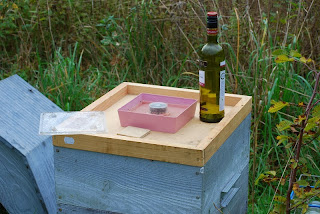
Usually I don't need to feed any of my bees before winter but due to the bad weather this year, especially the first 6 months, everything was behind with some colonies swarming as late as July with a corresponding slow build up in colony population strength. As things worked out it wasn't too bad by the end of August although the honey yield was poor, probably only about a third of what it should have been. Most hives were already well loaded and heavy with honey for the winter leaving all of September remaining to forage the ivy which was abundant this year. Ivy, a much maligned plant, is a great source of nectar and pollen for the bees at the end of the season and plays an important role for a number of species. However I had half a dozen underweight colonies from late reared Queens and I've been feeding these to boost their population size and hopefully get them up to weight with sufficient honey stores to get them through winter but I'm still left with th...